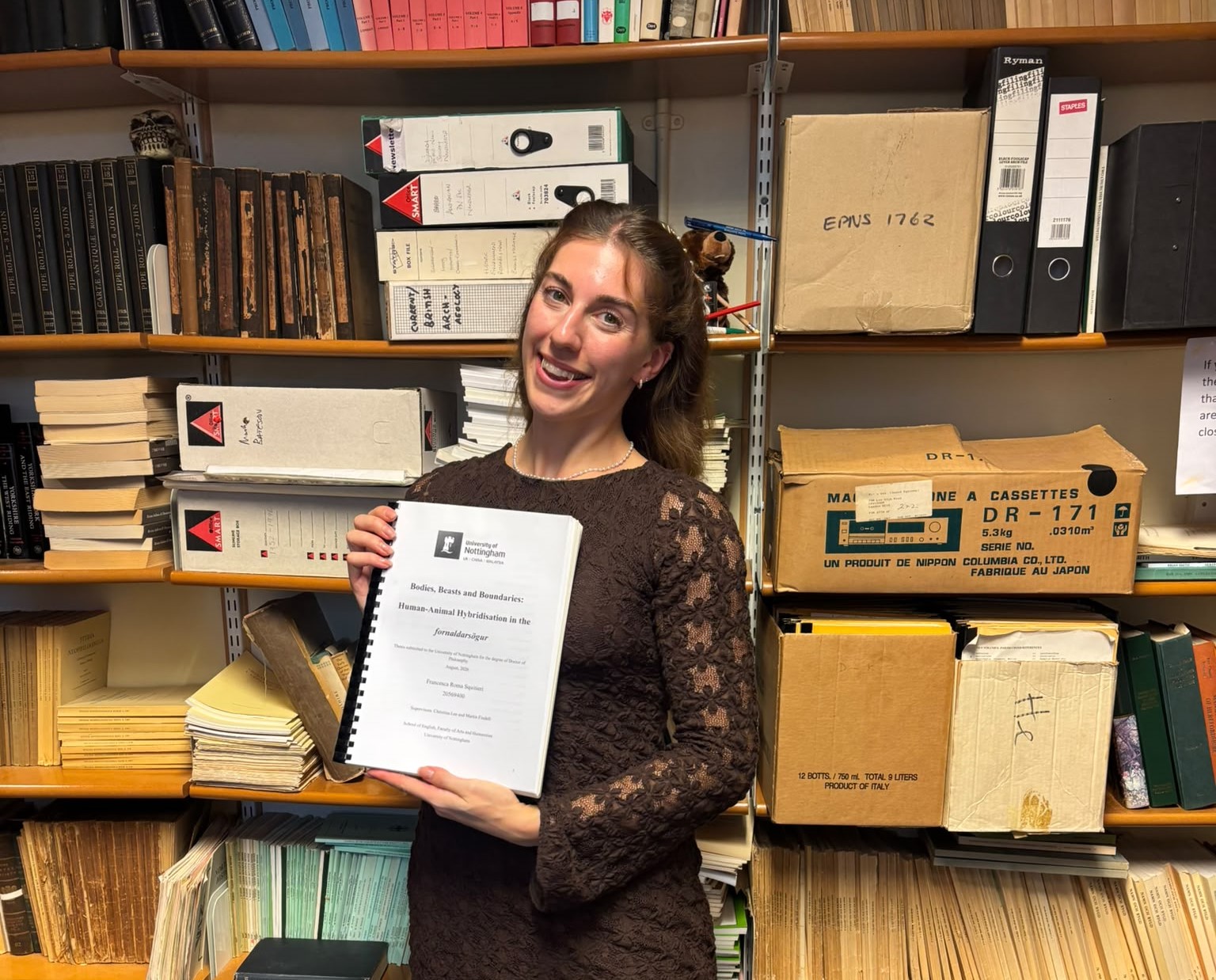
On 23 October 2026, after 3 years of research, writing, and hard work, I finally sat my PhD viva. I’m delighted to say that I passed with minor corrections! Although there is still some work to do, I can hopefully submit the final version and officially graduate in summer 2027. Reaching this milestone feels like the end of a very long chapter of my academic life – and perhaps the beginning of something new.
The final two years of my PhD have been something of a balancing act. Alongside researching and writing my thesis, I have been teaching full time in secondary education, juggling lesson planning, marking, classroom teaching, and the seemingly never-ending task of bringing a doctoral project to completion. Finding the time and energy to do justice to all commitments has not always been easy, but somehow, I made it work. Having started my PhD around three years ago, I am incredibly proud to have reached the viva stage within that timeframe, particularly while working full time.
Walking to campus on the morning of my viva, I felt a strange mixture of dread and anticipation. It was difficult not to feel as though all those years of undergraduate, master’s, and doctoral study had somehow culminated in this single afternoon. Every essay, every research question, every revision, and every moment of self-doubt seemed to have led me there. After so many years of working towards this point, the prospect of sitting down with two examiners to discuss my research felt both surreal and rather daunting.
Fortunately, I was lucky enough to have some wonderful friends who met me for lunch and coffee beforehand. Their company helped settle my nerves and reminded me that, whatever happened in the viva, I had people around me who were rooting for me. My supervisors were equally supportive. I spent some time sitting in their office, trying to relax while waiting for the viva chair to arrive and take me to the room where the examination would take place.
And then, suddenly, it was time.
One of the things that surprised me most about the viva was how much I genuinely enjoyed discussing my research. There were some fascinating questions about my methodology, why I had chosen this particular topic and corpus, and how I had selected the texts and animals that formed the focus of my thesis. Having spent so long immersed in the material, it was rewarding to have the opportunity to explain the decisions behind my research and to think more critically about the approaches I had taken.
Of course, not every discussion was straightforward! Some of the more heated exchanges concerned areas of research that I had not explored in enormous detail, including the Sámi and Finn communities mentioned in the fornaldarsögur (legendary sagas). These were valuable conversations, and they highlighted just how many fascinating avenues there are still to explore within the material.
At the same time, I had to acknowledge the practical limitations of a doctoral thesis. At approximately 95,000 words, my thesis was already approaching the maximum permitted length of 100,000 words. With such a complex project, there is only so much that can be discussed in detail within a single piece of research. Part of completing a PhD is learning to make difficult decisions about scope: deciding what to include, what to leave aside, and where further research might take you.
Both examiners were attentive and considerate throughout the process. Their questions challenged me to reflect on my work, while their feedback gave me a clearer sense of how to strengthen the final thesis. I came away with a set of notes and corrections that will help me produce the strongest version of the research I can.
And, most importantly, I came away having passed!
After the viva, my supervisors came in to celebrate, and elsewhere in the Trent Building, my friends were waiting with a card and a bottle of fizz. Having spent so much of the last three years working independently, it was wonderful to share the moment with the people who had supported me along the way.
We went out for dinner and celebrated what felt like the end of an era. There was a real sense of relief in finally being able to pause and acknowledge what I had achieved. A PhD can be an intensely personal undertaking: so much of the work happens alone, behind a laptop screen, surrounded by books and articles, trying to make sense of an argument that sometimes seems to grow more complicated the longer you work on it. Having friends, supervisors, and colleagues who encourage you, challenge you, and celebrate your successes makes an enormous difference.
I am particularly grateful to everyone who helped me reach this point, whether by offering academic guidance, listening to me talk through a difficult chapter, providing a welcome distraction, or simply reminding me that there is life beyond the thesis.
For now, there are still corrections to complete before I can submit my final thesis and graduate in summer 2027. Nevertheless, passing the viva has given me the chance to take a breath and reflect on what comes next.
At the moment, I am still enjoying my career in secondary education. Teaching full time alongside my PhD has been challenging, but it has also given me a career and a community beyond academia, and I am grateful for the experiences it has brought me. I don’t yet know what the future holds, whether that means continuing to develop my research, exploring new projects, or perhaps even pursuing postdoctoral study.
What I do know is that I am excited to see where the next chapter leads. Completing a PhD does not mean that all the questions have been answered; if anything, the process has left me with more questions, new interests, and plenty of ideas that I would love to explore further.
For Bodies and Being, too, this milestone feels like a fitting moment to reflect on the relationship between research, teaching, and the communities that sustain our work. Scholarship is rarely a solitary endeavour in practice, even when so much of it takes place alone. It grows through conversations, collaborations, challenges, and the generosity of people willing to engage with our ideas.
For now, I am celebrating the fact that I made it through the viva, that the thesis is almost finished, and that I can finally see the end of this particular journey. The final submission is still to come, but I am allowing myself to enjoy this moment.
Here’s to the end of an era – and, hopefully, the beginning of another.

