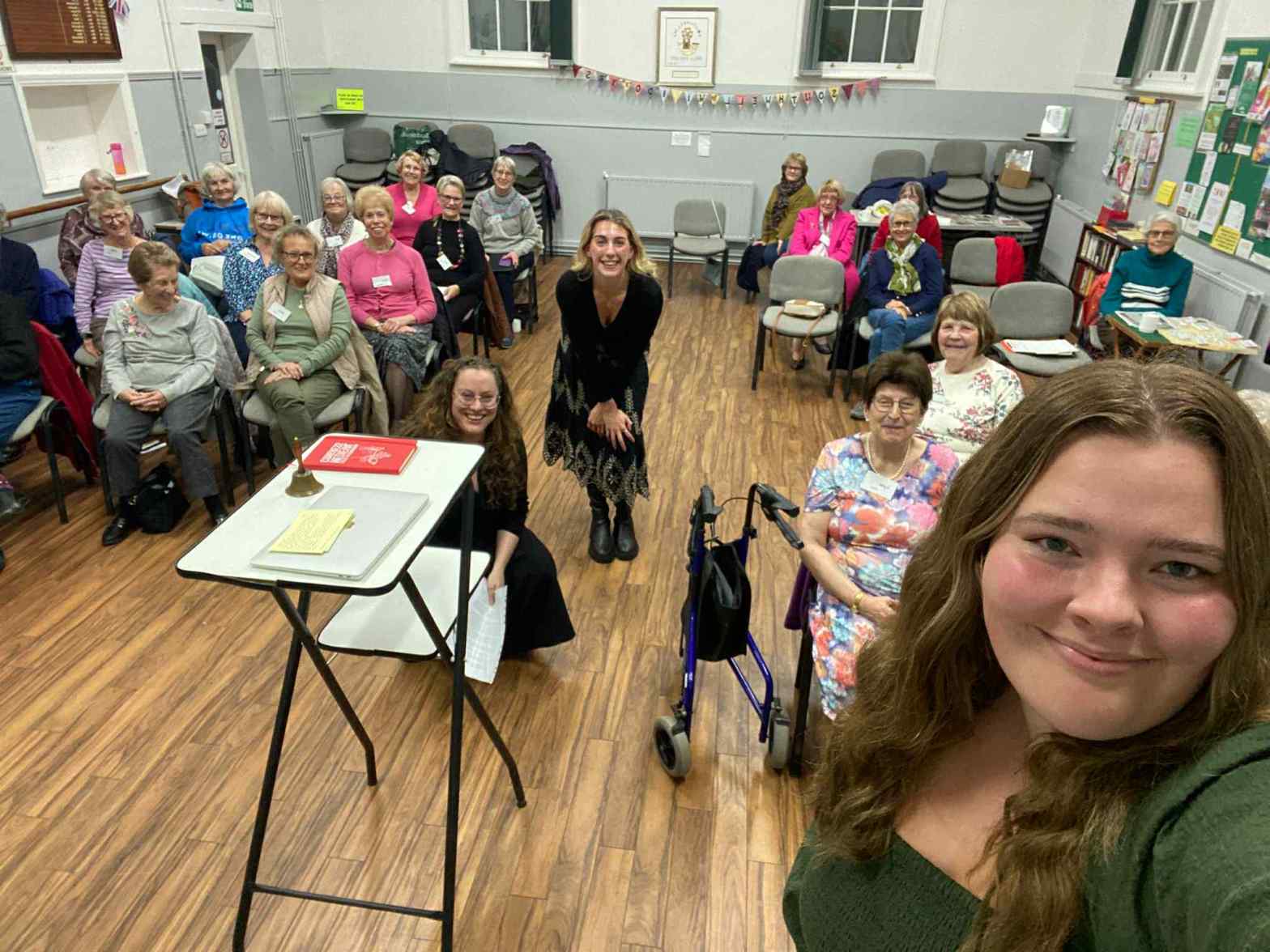
On Tuesday, 14th October, three of us from the University of Nottingham’s medievalist PhD community had the pleasure of giving a talk for the Southwell branch of the Women’s Institute. The event took place in the beautiful and historic setting of Southwell, a town whose quiet, lamplit streets provided the perfect backdrop for an evening of storytelling about women of the Viking Age.
Several months earlier, the WI had reached out to the University to ask whether there might be any PhD students willing to speak about Viking women. My two friends, Em and Jaz, and I volunteered right away. Between us, we cover different areas of medieval studies, and we saw this as a great opportunity to combine our expertise and paint a fuller, more vivid picture of women’s lives in the Viking Age.
We arrived at the venue just before 7pm and were warmly welcomed by the members of the WI. Before our talk began, we had the chance to see what a WI meeting is like — complete with friendly conversation, tea, and biscuits. The group made sure we had everything we needed to set up (even though we had a few hiccups with the tech!).
Em began our presentation by setting the scene: she introduced the audience to the Icelandic family sagas and the powerful, passionate women who inhabit their pages. From far-travelling settlers in the Americas to land-taking founders of early Iceland, Em explored how the voices and actions of women have been preserved in some of the oldest stories of the Norse world.
I followed with a discussion of the Legendary Sagas, focusing on Vǫlsunga saga and Ragnars saga loðbrókar. These narratives feature remarkable women such as Brynhildr, Guðrún, and Áslaug, whose influence shaped the fate of heroes and dynasties alike. I also touched on how the traditionally feminine arts of weaving and needlecraft (inspired by the displays of quilting, applique and sewing around the WI hall) were viewed as powerful, even fateful, in Norse culture. The very ships that defined the Viking Age could not have sailed without their finely woven sails — the work of women — a reminder that their labour and skill were foundational to Norse society and identity.
Jaz concluded our talk with a brilliant exploration of Viking runestones across the Norse world. Drawing on her expertise in early runic inscriptions, she shared striking examples of memorial stones commissioned for — or by — women. Her discussion illuminated how women’s presence and agency are carved, quite literally, into the material landscape of the Viking Age.
After an hour of speaking, we opened the floor to questions. The audience was wonderfully engaged and curious, asking about everything from saga storytelling and runic art to the resonances between women’s lives in the past and today. Many attendees stayed behind afterward to chat with us individually about our research, academic journeys, and future plans.
It was an incredibly rewarding evening — not only to share our work beyond the university, but also to see how warmly it was received. Several WI members remarked on how refreshing it was to have three young women speak confidently and passionately about such a specialised subject. They even asked if they could share our details with other WI groups interested in inviting us to speak in the future — an invitation we’d be delighted to accept.
For us, this event was a meaningful reminder of why community engagement matters. The medieval world might seem distant, but its stories still resonate powerfully today. We left Southwell inspired by the conversations we’d had, and excited to continue finding ways to connect our academic research with wider audiences.
 Bodies and Being