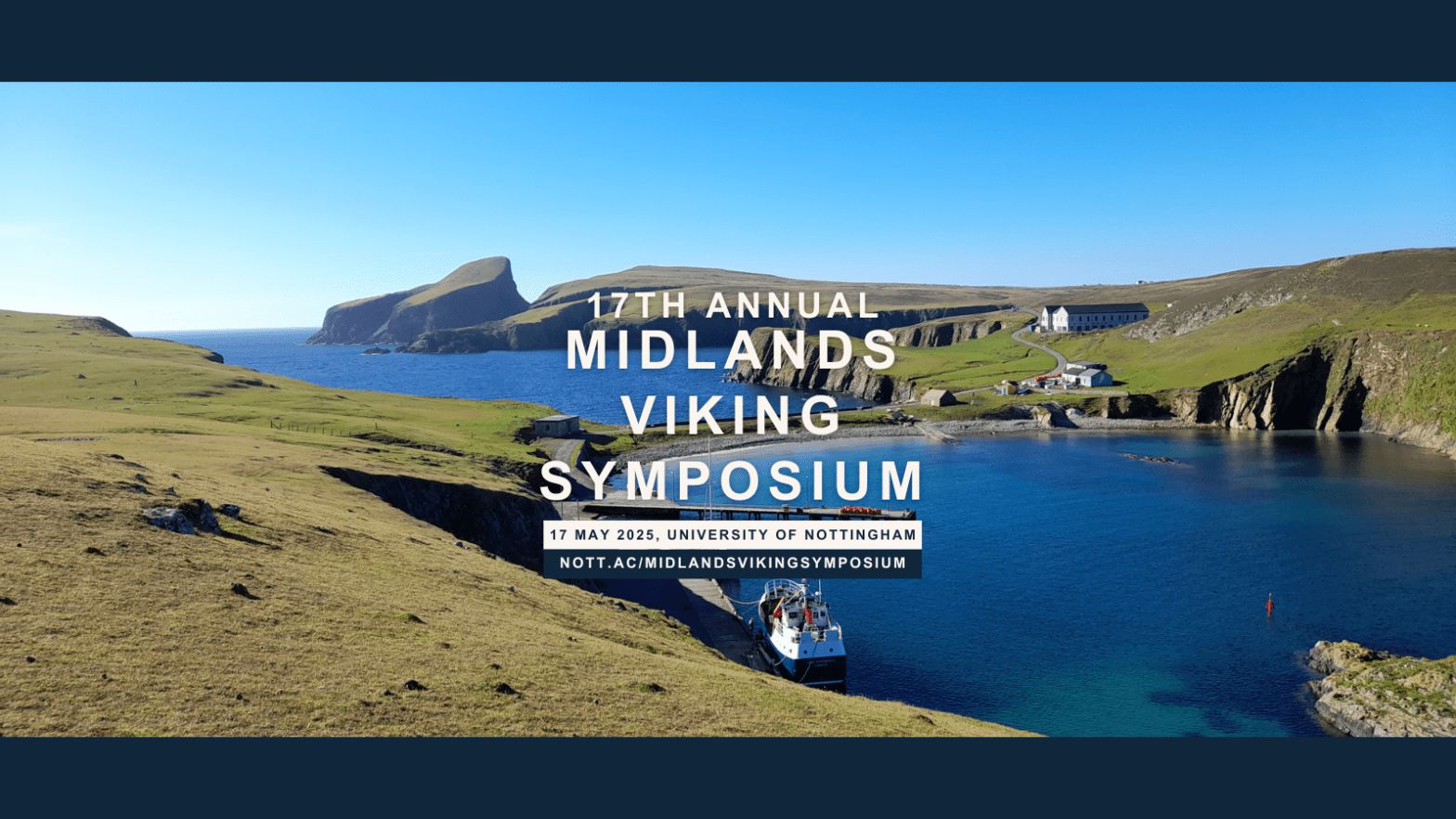
On Saturday 17th May 2025, I had the pleasure of attending—and presenting at—the 17th annual Midlands Viking Symposium. Founded by Dr Christina Lee (University of Nottnigham) the symposium is a one-day event dedicated to sharing the latest Viking research with public audiences and academic colleagues across the region. Held this year at the University of Nottingham, the Symposium brought together a vibrant community of researchers, students, creatives, and curious minds for a day of talks, discussion, and hands-on engagement with the Viking past.
As excited as I was for the day, it was daunting to be the first speaker of the first panel and open the day’s presentations. Nevertheless, I was delighted to present my paper, “The Boundaries of the Body: Fáfnir the Dragon in Vǫlsunga saga,” which examined how monstrous transformation in the legendary sagas interrogates the limits of the human form. The discussion that followed reflected the Symposium’s wonderfully interdisciplinary spirit, with comments and questions from academics, students, and non-specialists alike.
The 2025 programme was particularly exciting, not least because of the keynote address by Professor Clare Downham (University of Liverpool), current President of the Viking Society for Northern Research. Her paper on the Siege of Chester offered fresh perspectives on the cultural and historical dynamics of the Viking world and set the tone for a day of stimulating conversation.
It was also fantastic to see contributions from the ERC-funded BODY-POLITICS project (University of Leicester). Their work explores embodied experience and the political dimensions of the early medieval body—a perfect complement to our own focus here at Bodies and Being. One of the highlights of the day was their innovative card game, ‘Gaards! Gaards!’ which invited participants to engage more actively with the Norse settlement of Iceland and the challenges this created.
Throughout the day, attendees had the opportunity to browse stalls from BlueAxe Reproductions, Bookwise, Brepols, and the English Place-Name Society—a tactile reminder of the material cultures that continue to shape our understanding of the Viking past. These objects became a source of inspiration for the closing session, a creative writing workshop led by historical fiction author Dr James Aitcheson. Drawing on both the day’s scholarship and the reconstructed artefacts, participants were encouraged to weave their own narratives grounded in the Viking world. I found Jasmin Higgs’ paper “Determining the Functions of the Pre-Old English Runic Inscriptions” particualrly inspirational for my own fictional narrative as her research conveyed the importance of personal objects and inscriptions. The atmosphere was energising, supportive, and entertaining. It was so wonderful to listen to the stories crafted by members of the conference, and it was a brilliant way to connect more personally with the viking past.
None of this would have been possible without the outstanding organisation of Dr Kate Olley (University of Nottingham), who ensured the day ran smoothly and remained inclusive and engaging throughout. Her efforts created space for meaningful dialogue between disciplines, generations, and interests—exactly the kind of community-focused scholarship we value at Bodies and Being.
In all, the Midlands Viking Symposium 2025 was a joyful, thought-provoking event that reminded me how collaborative and creative the study of the past can be. Whether you were there for the dragons, the runes, the poetry, or the card games, there was something for everyone.
I already can’t wait for next year.
 Bodies and Being