I am so excited to see how many of my colleagues and peers have responded to the birth of Bodies and Being: The Premodern Body Project, co-founded by myself (Autumn), Francesca, James, and Natalie. I shouldn’t really be surprised though since it’s clear that body studies have really taken hold in just about every field. Every week it seems like I am adding a new book to my TBR or registering for another fascinating premodern body-centric talk. I hope that this means that we’ll see quite a bit of interest from many of you in giving talks as part of our monthly seminar series.
I think that what really interests me about bodies is how contingent they are. I think most people take their body for granted and only speculate theoretically about a time when their body might change. But even then, I’m not sure they understand the full implications of being a body. Having a body means that yes, it will change, no doubt, but it will likely not be the way we think of it as we gaze wistfully back at our twenties. We think about eyesight failing, getting tired as we age, etc, but do we ever really internalize that, for example, most of us will at some point become disabled in some way? But what really, really interests me is not necessarily age or disability but what it means to experience the world through a wide range of bodies within a specific cultural and historical context.
Bear with me. Think about those examples above. They are all examples that are more or less universal. Those of us lucky enough to age will likely struggle with failing eyesight or fading memory. Some of us may even lose a limb to severe illness or become paralyzed. But while being sick or disabled may theoretically be a universal experience, how we experience it as a body differs dramatically by time, wealth, race, and geography. Having a baby as a white woman in the United States, where my daughter was born, was relatively painless. My body experienced postpartum depression and exhaustion within a context of modern isolation. Having a baby in 1450 in rural England would be another matter. My body would perhaps experience more pain and exhaustion, especially if I must continue to work, nurse a baby, or labor in a field. Arguably, my 21st century body experienced a more clinical kind of touch in a sterile, fluorescent lit room while my 1450 body was handled by friends in the village who helped tie relics to my waist and fed me soothing drinks. My body’s experience in 1450 may cause me to view childbirth differently than did my 21st century body. These are very generalized and generic examples, but I hope they show that studying the historical body is about much more than just studying the body as a theoretical or even as an object. It is about understanding how contingent our bodies are, in our lifetime as well as throughout all of history.
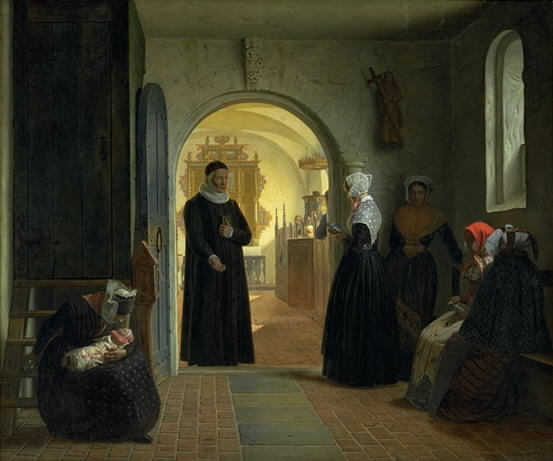
My own work focuses on women’s bodies in early modern English religion, in particular, how women’s bodies experienced liturgical change. I examine the development of churching (a rite that brings post partum women back into the religious community
through purification). Previously scholars have focused on the theoretical – what did churching “mean”? Was it religious misogyny? Did women like it or hate it? These are worthy avenues of exploration, but I am interested in what I can glean about women’s bodily experiences as they moved through this rite and through Reformation religion. This is understandably difficult. There are not many sources that record a woman’s attitude to the rite let alone how her body experienced it. So, I must get at this from a different angle and “read” gesture. What movements are women recorded as performing and what might they say about her bodily experience of the rite? When men made changes to the ceremony, where did they stage women’s bodies and why? How did women show, through gesture or clothing, how they felt about these changes? What intrigues me most so far is how much agency women’s bodily experiences had when it came to liturgical reform. For example, simply by donning or removing a veil could signal a woman’s attitude toward cultic purity. In short, women’s bodies and, most importantly, their bodily experiences, were fundamental to the struggle to reform liturgy and in this way, women played a remarkable role in the reformation that is rarely taken as seriously as it should be.
Contingency is key. Churching, after all, still exists. Women’s bodies still experience churching. But the context has changed. Cultural attitudes, theology, even the physical space of the sanctuary has altered and thus so has the experience. If I wasn’t so stuck in the past, I might find myself curious to compare churching in the two periods. But I have enough to do with early modern England. I want to apply this preoccupation of contingency to many other areas. For example, how did women’s bodies experience the mass production and greater affordability of mirrors in an age in which they would rarely have seen their own faces? That one really haunts me as someone approaching middle age who regularly checks the mirror for the errant chin hair. Historical Autumn would be running around early modern England experiencing life with a full beard.
I hope that you’re all just as excited by the field of historical body studies as we are. We are looking forward to growing this project to include lots of seminars and even monthly online hangouts where we can meet each other, chat about our work, and ask questions. Please don’t hesitate to email us with questions or comments at Bodiesandbeing@gmail.com.
 Bodies and Being